Tuesday, April 14, 2009

The Future is Awesome and Now

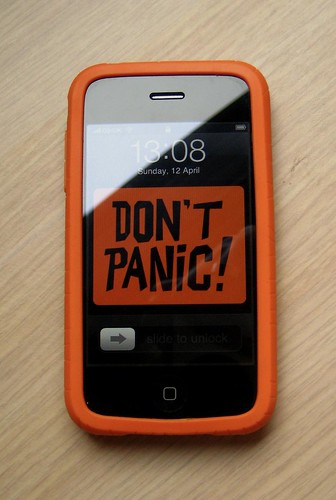
My Hitch Hiker's Guide to the Galaxy


I have a confession to make. It's not a bad one but here goes. I bought an iPhone. Before anyone gets all judgemental I should point out that the 'phone it replaces is eight years old and was finally really beginning to show its age by refusing to hold much of a battery charge, switching itself off every now and again and generally just getting a little eccentric in its dotage. I have searched for 'phones for a long time now but none of them were smart enough to justify the extra expense or space that they take up to justify getting one. Finally my elderly Nokia became too senile and had to be retired. Enter the iPhone. I have to say I am incredibly impressed. Here is a device I can watch TV on, stream radio on, listen to my podcasts on, catch up with T.V episodes, keep tabs on the news, my e-mail, my calendar and and and. I was, and indeed am, slightly overwhelmed by it all and have been struggling to find some frame of reference for how exciting the ownership experience has been but Saturday finally provided it.


Having had lunch with T's family I was due to jump on a 'bus and head south of the river to Camberwell for a friend's birthday. I stopped off at Fortnum and Mason to get a cake as a gift and during the time I was in the shop a huge protest march of 100,000 angry Tamils had started past the front of the shop cutting off my route back. I had, at that time, no idea how big the march was, where it had started from nor where it was headed so I couldn't work out which way to walk and which 'bus to try and catch.

Enter the iPhone, or Hitch Hiker's Guide to the Galaxy as I'm now calling it. From the BBC website I was able to find out how big the march was going to be: answer - Huge. Damn. I was then able to find a map of the route the march was to take and from that using the mapping tools on the 'phone plan a route I could take to circumvent the protesters as efficiently as possible. Next I was able to look up which 'bus routes were affected and thus to plan the rest of my walk to get me to the one open bridge across the Thames that had a bus service of use to me. I reckon the iPhone saved me a good hour of aimless wandering and it meant I was only a few minutes late. Sometimes I really feel like I'm living in the future and it's amazing to me.

Labels:

Tuesday, July 01, 2008

Sun Burn

I spent all yesterday at Pinewood Studios for a miniature shoot for the film I'm currently working on. It was an 8 a.m. call meaning that I was in a car at about 7 a.m. heading up there. As usual the day went very slowly and we were out on the back lot for most of it. You learn pretty fast that hearing "going on set" should trigger the thought "take some sun-block". I did remember this and covered my lily-coloured geek-pasty skin with factor 50 for the whole day. I felt a bit slimy but only the tops of my ears got a little toasty. The one highlight of the day was the inevitable fried breakfast in the Pinewood canteen. It's a very long way from sophisticated dining, quite like school dinners, but we must take our crumbs of comfort where we may. I did see one, rather large, fellow with a plate stacked with a baked potato and chips. Very fond of potato obviously.

On the journey back the car that came to collect us was a Toyota Prius, the hybrid car. I have seen plenty about but never had a ride in one. I was rather impressed. It was quiet, comfortable and brisk. With me (a little over six foot) and my colleague of similar height behind me we both had enough legroom to be comfortable and in a car of that size you can't often say that. The driver was saying that the saving in fuel from the hybrid car over the Mercedes he used to drive was over £200 a week. Now obviously this guy does serious mileages but to be able to save £10 000 a year in fuel is crazy. If were thinking of buying a car, which I'm not, I'd definitely put the Prius on the list.

In Hellboy 2 promo news there's a new trailer out which has excerpts from three of the shots I did. There's a whole lot of stone giant in this one at about 1:10 in:


OK, self-promotion over. Time for bed.

Labels: , , ,

Tuesday, June 24, 2008

Truly I am a God

The Spore Creature Creator was finally made available and after a couple of false starts (you can buy it for the Mac now but you can't actually have it yet) we got a version working on Tinseltroos' PC. We were pretty cross after all the installing, uninstalling, upgrading and other Microsoft based yadda yadda needed to make it work but when it did, boy it didn't disappoint. For those not in the know, Spore is a game where you can design your own organisms and watch them live out lives, evolve and develop until they become sentient and then go off to explore their galaxy. Pretty much the ultimate in God Games. At present only the creature designer is available but that on its own is so much fun. Sticking limbs and sensory organs all over your creature, scaling them, tweaking their shapes until you have your finished beastie is incredibly entertaining. Here a re a couple of creatures I made yesterday. First is a Snufflodon with its young:

Snufflodon and Young

And here's my take on an Elder Thing from H P Lovecraft's At The Mountains of Madness:

Lovecraftian Elder One

What a little cutie. You can probably expect more creatures to appear over the coming weeks, I don't see myself getting bored with this one anytime soon.

Labels: , , ,

Tuesday, June 03, 2008

Don't Upset the Roomba

Here is the back story. On Sunday Tinseltroos was out of the flat for of her regular Bollywood marathons so it was just Murphy and me. Murphy is a regular little trooper but he only has enough puff to vacuum half of the flat in a single charge after which he has to go and have a little rest. I needed to go and do some shopping so I set Murph off to do one half. Later on I went out again to see Indiana Jones and the Kingdom of the Crystal Skull again (I make no apologies, I love it) so Murph got to clean the other half of the flat. The little guy did an admirable job and we had a nice clean flat.

On Monday Tinseltroos, not realising that Murphy had already done both sides of the flat, set him off to do the hallway and living room again. Murphy took umbrage at this, I suspect he felt it was slight on his workmanship from the previous day and duly when I returned home it was to a scene of a devastation. Murphy had scattered the neatly arranged collection of recycling everywhere. Cans, beer bottles and milk containers littered the entire flat. In a final, desperate act of self destructive rebellion Murphy had knocked his own power supply out of the wall and driven himself on top of it: a clear plea for help I think.

I carefully untangled the unhappy little robot and plugged his charger back in. After petting him a little and reassuring him that he was still very much loved and was a very good little robot I plugged him back in and went about the flat picking up the remnants of his day long bender.

We haven't had the heart to ask him to clean any of the flat this week. With luck he will have forgiven us by tomorrow.

Labels: , , ,

Friday, May 30, 2008

Pinky Drive


I've been having another "Oh my freaking Jeebus, I'm living in the future" day. My venerable old USB thumbdrive which, when I bought it 5 years ago packed an astounding 128mb of memory, has finally fallen apart. And so it was that I braved Tottenham Court Road this lunchtime to get something with which to replace it.

After my slack-jawed amazement when I got a micro-SD card for my Nintendo DS homebrew kit I thought I'd seen it all. But no. Sony have now made "Tiny Vault" USB drives that are about the size of half a stick of gums. It's absolutely tiny and yet it is mountable as a drive on a computer and somehow manages to fit 4Gb storage within its tiny frame. Initially I just stared at the packages on the shelves for a while trying to figure out the catch, trying to work out if it was actually a drive in its own right or whether it was like a camera flash drive and would need an adapter. No adapter is needed. I must have looked like the first person to be shown television staring at this glowing box and wondering how they managed to fit all those tiny people inside it. Having convinced myself that it was what I wanted I purchased the wee fellow and have just copied 2.6 Gb of data onto it. Essentially I now have a gizmo which is capable of storing the whole of the Encyclopaedia Britannica and yet is also easily swallowable. That's a scary thought. Now where the hell did I put it down?

Labels: ,

Thursday, May 01, 2008

...Robot Update...Robot Update...Robot Update...

This morning we left Murphy to clean up the hall as we went out to vote and then work. When we returned home we found a couple of scattered beer bottles and Murph' had passed out having climbed half way up one of my guitar stands. He was completely unconscious, resting on one wheel. I think he must going through a period of teenage rebellion, experimenting with drink and today he got caught out.

As gingerly as I could I carried him back to his bed to have a charge and sleep off the worst of whatever he's imbibed. Tomorrow we shall have a frank conversation about the dangers of drinking too much, especially on a school night.

Labels: ,

Friday, April 18, 2008

I For One Welcome Our New Robot Overlords

There is a new thing in Schossadlerflug. A friend of ours, who currently has a bad back and a new book deal decided that what her life needed was less vacuuming and more future. To that end she bought a Roomba, a small robotic vacuum cleaner. Tinseltroos, who has been working serious overtime of late and is in a self-present state of mind was not about to let that slide and so took herself off to John Lewis yesterday and returned with a Roomba of our own.

The Roomba, or Murphy as it is now known, sits in the hall in its Roomba hutch waiting expectantly for one or other of us to tickle it behind its robotic ear and press the "clean" button. On that command it chirrups happily and then blunders around the flat bumping into things. At present I do not fear imminent take-over by our heavily-armed robotic nemeses as the Roomba is clearly far too stupid. It tried to shut itself in the bedroom repeatedly by knocking out the wedge that keeps the door open five times. That said, for a wee machine it does a good job and once you've removed things like boot laces off the floor it gets along just fine. There was a moment on its first sortie last night where it attempted to eat one of Tinseltroos' piratey boots and we had to perform open Roomba surgery to disentangle the laces from its innards.

I can tell that I'm going to have an ongoing series of existential crises with this thing. For example I already feel guilty about switching it on to clean the living room as we left for work this morning. Poor little guy, all alone in the flat, with nothing in its life apart from cleaning for ungrateful humans. I feel quite wretched that we'll get home where it will have happily peeped to unlistening ears to announce that it has found its little house and is going to have a quiet charge for a bit. I feel wretched and I shouldn't. God I hate this inability I have not to form meaningful relationships with pieces of technology. I'm certain that the Roomba does not feel the same way but then we've all been in those unrequited affection situations haven't we?

If I get home and the floor is clean and the Roomba is sat it its hutch quietly like an obedient spaniel I shall probably cry. If, on the other hand, I find the flat empty with only a sprinkling of saw-dust to hint at the previous existence of my guitars there will be trouble. If I also find a fat little Roomba sat on the sofa, complaining about how full it is, watching our TV and drinking my scotch then there'll be hell to pay.

Labels: , ,

Tuesday, April 15, 2008

Living in the Future


In 1991 my dad bought himself an Apple Macintosh Classic, a lovely little computer which is still in a box at my mum's until I can think of something fun to do with it. It was a spritely little beast back then with an 8 Mhz processor, a scarcely believeable 20 Mb hard drive and an entire megabyte of RAM. I thought this little bugger was the bee's knees.

I have just had my studio workstation upgraded today. The new slab of technology now keeping my feet toasty and warm is 3400 times faster than my dad's old Mac, has 16000 times as much memory and 15000 times as much hard disk space. I think if you'd told me that in 1991, my head would have gone pop. Many people seem to get blasé about the rate of development in technology but every new leap forward makes me catch my breath. These are exciting and weird times, Bubba.

Labels: , ,

Saturday, February 16, 2008

Age Before Beauty

Yesterday was the day when I decided the time had come to get a new domestic laptop. I have two laptops, one for work that has Maya, Shake, Photoshop and so on, and another consumer spec machine for surfing the net, iTunes and all that kind of thing. My original domestic machine is now nearly five years old and in this high-def, broadband, widescreen world its creaky 800Mhz Power PC chip doesn't really cut the mustard anymore. Having done my research I'd decided upon an Apple MacBook. My feelings about Apple, their stores and their corporate culture have been covered in detail in the past here so you will no doubt be unsurprised that I entered the Apple Store on Regent Street with some trepidation.

I was almost immediately accosted by a spotty emo youth who was, at a guess, about nineteen. Did he have a black MacBook with 2Gb RAM in stock I asked? He consulted his Star Trek tricoder thingy. Indeed he did. Thirty seconds later, and without getting anywhere near a cash register my bank account was suddenly considerably lighter and I had a very pretty cardboard box in my sweaty little hand. The callow youth inquired whether I had used a Mac before? I answered in the affirmative. He then asked if I used any of their professional applications? I answered that I used Shake. He informed me that they did training courses in Shake in the store. This was the moment where I had to bite my aging lip. My desire to say, "Young man, I have been using Shake, in all its many guises, since before you started secondary school" was almost uncontainable, but contain it I did. I smiled and explained that I was quite used to the sofware now and had become reasonably adept. He seemed surprised that somoeone so old should have even heard of their professional compositing application, let alone claim to know a bit about it. Bloody kids.

Labels: ,

Wednesday, January 23, 2008

Noises


So I didn't spend the evening playing Super Mario Galaxy after all. When I got home the guitars were staring at me with their shiny, new, silvery strings. I was also keen to try out a few different sound settings on my guitar amp simulator box thing. I found a nice bluesy backing track from a CD and layered three different guitar parts over it: one clean blues, one more hard rock and a bit of slide to finish it off. I also wanted to see also how GarageBand coped with all the different sounds and how well it mixed them down. It's completely improvised as you'll be able to tell but it's as much of a testing equipment piece as it is just me mucking about for the fun of it. I continue to be amazed at how good GarageBand is for a super cheapy piece of software. It automatically picks up when I connect the guitar amp simulator box thing and allows me not only to record from it without any latency but also sends all the audio back in to the wee box and out to the speakers so I can hear everything as I'm playing without having to use headphones. I remember trying to record anything was a huge exercise in heartache before it all went digital. Have to love technology and what it can do for you sometimes.

You can see, well hear, how I did in the "movie" above. For some reason Blogger won't let you upload just sound so I had to create a video using a still photo to go with it. Go figure.


Just call me Short-sighted Kumquat Atrocity. It's my new blues name.

Labels: , ,

Monday, January 14, 2008

Lazarus


So the laptop's alive again. Having died on Saturday morning it remained silent when it was plugged into the mains and no amount of pushing of power buttons and other reset tricks had any effect for two days. As a last gasp test I charged the battery over night so I was sure it was full and gave the power button one more prod this morning, just to confirm it was defunct and that my appointment with the "genius" would have to take place tonight. It coughed a bit, spluttered and woke up, very dazed and confused but definitely alive. After a few minutes of spinning pizza of death it set itself back to the state it was in when I put it to sleep on Friday night. How bizarre, for truly it rose again on the third day. Perhaps my Powerbook is holy? Even if this is the explanation I'm still going to keep the "genius" appointment as I want to know if this was a portent of bad things to come, or to put it another way: "Should I back my data up more often?"

This will mean going to the Apple Store and speaking with a self-appointed "genius". I really hate that place. I have used Macs for a few years now because I got utterly sick of the constant driver/update/crap engineering that I seemed to suffer with Windows and whatever hardware I tried it on. Until about 5 years ago it still seemed as if this was a better bet than Macs, which I'd always hated using before OS X came out. I really like OS X. I like its Unix underpinnings - an operating system I've been using for well over a decade and have therefore got very comfortable with plus the user-interface of OS X is very pleasant to use and I haven't had a lot of the compatibility issues that my last three Windows machines exhibited. However I hate the smug gittishness of the Apple brand, its advertising, its homogenously blander-than-bland modernist shops and the messianic fanboyish genuflection whenever Steve Jobs opens his cake-hole. I like Apple computers (until something better comes along), I do not like idolatry. This evening I shall have to at least pretend to be one of the "true faith" even if I'm actually profoundly agnostic on the matter.

Labels: ,

Saturday, January 12, 2008

Rotten Apple


Epler i vann (apples in water), originally uploaded by Åsta.

Blogging will be light for the foreseeable future as my laptop died this morning. I can only really access the internet at work now and my employers, spoilsports that they are, expect me to do their bidding during work hours even on weekend work days like today.

I have no idea what's up with it. There is no action when you press power so I'm thinking it's a mechanical rather than software problem and power related rather than a poorly hard-drive. We will see what the "genius" at the "Genius Bar" advises when I can get an appointment to see one, which will be Monday at the earliest. I'm really hoping that the repair is cheap, I don't want to be buying a new computer at this moment.

Labels: , ,

Saturday, November 17, 2007

The Backlash Against Computer Generated Imagery

N.B. I have not corrected any of the quotes in this piece for spelling or grammar. They are mostly culled from the comments section of this article in The Guardian and, as is common for comments they are posted in a very stream of consciousness fashion with little proof-reading. Please imagine your own (sic) throughout.


"Now I should point out before we begin that I have major, major issues with digital effects. I had to go through several months of counselling after witnessing the sight of Jabba the Hut digitally recreated and superimposed onto a previously deleted scene in the "updated" version of the first Star Wars film (I refuse to refer to it as A New Hope). And I haven't yet seen Elizabeth: The Golden Age, but plan to keep things that way after viewing the trailer, which features a Spanish Armada rendered completely devoid of grandeur and menace through the use of CGI.
...
"Frankly, I would happily see a blanket ban on all digital effects in film, tomorrow. Imagine if science fiction movie makers had to use their ingenuity again when depicting spaceships and monsters (as in the original Alien). We might witness a return to the practice of using scale models, such as those in the original Star Wars films, which were 100 times more realistic than their CGI equivalents in George Lucas' rubbish triptych of prequels." - Ben Child writing in The Guardian

For every well reasoned piece written about CGI there are a mountain demanding a backlash. Most of these pieces and innumerable fora comments are targeted against computer generated visual effects and this week came the call, albeit tongue in cheek, for all CGI to be banned. There seem to be two strands to the complaint. The first is that films with visual effects are aesthetically inferior to those without. This argument is generally couched in terms like "not real" or "fake looking". This is a complaint about the actual imagery produced. The second line of attack comes against the processes themselves and those who use them. Digital effects are created by "boffins" rather than artists and they are made "by a computer", the implication being that no human effort or talent has been expended in their production. Directors are lambasted for resorting to digital trickery rather than using ingenuity and talent as previous generations had.

Before examining the state of digital visual effects it is perhaps worth looking at what qualities are lauded by these critics and therefore, by extension, what CGI apparently lacks. The over-riding concern seems to be one of ingenuity and craft. The hand-crafted models in the 1977 version of Star Wars are regarded more highly than the digital creations in Revenge of the Sith. The question is why? Are they more realistic? This is a very loaded question. Realism is a slippery beast. Is the complaint that, if the film-makers were to construct full size examples of these ships, put them into orbit and photograph them and then compared that footage with a CGI version and a traditional model, the model would more closely resemble the real plate? That is a tough question to answer objectively in this instance. We can however compare the huge amount of virtual set work done using CGI where a digital element takes over from a practical set. Take the exterior of Newark Airport in United 93. This and every aircraft exterior was created digitally, apparently without complaint. If therefore, digital effects artists were able to create, with scientific precision, an object would that then be acceptable or is there more subjectivity at work here?

When Troy was released, complaints were raised in some corners that the ships in the Greek armada had too tiny wakes and almost no bow-wave, a sure sign they said of CGI trickery. A little nautical knowledge is a dangerous thing. The Greek penteconters upon which the CG armada was based were keel-less and had a very shallow draft. There is minimal surface contact between the boat and the sea because it is much harder to row a boat that sits deeply in the water, overcoming drag becomes exhausting and your crew mutinees. These ships create no wake at all, one can examine footage of the 'Olympias', the trireme (a much larger vessel) built for the Greek navy in the 1980s. When creating the effects for the film, the VFX team, of whom I was one, elected to put some wake in as we felt, artistically, it looked odd without them. Perhaps we did not add enough fakery to make the ships believable to that section of the audience. The bow waves were photographically sampled from a real penteconter and layered onto the CGI ships incidentally; they could not have been "more real". The difference between realism and believability is key. They are not synonymous. It is not "reality" that the opponents of CGI crave, it is a believability that they see modern films with digital effects lacking.

Believability of course implies "suspension of disbelief". Everyone, but the most credulous, is aware that fictional films are just that. The events portrayed did not occur. Looking at the mechanics of film-making we do not in reality see in a series of edited long-shots and close-ups. We however buy into their believability because of our continuous exposure to them from the first moment we are placed in front of a television as a tot. We absorb what these devices mean to the point where we no longer need consciously to decode them. Much as when reading a novel the experienced reader does not consciously decode the squiggles on a page into letters, process the assortment of letters into a word and then recall the meaning of that word - this happens subconsciously. We experience cinema similarly, there are tropes, conventions and stylistic choices we learn instantly to decode. Puppetry and model making fall into this category. We understand, certainly in the case of films we saw uncritically as children, the symbolism of the animated Talos in Jason and the Argonauts. Though beautifully animated what we see on screen in no way matches what a 100ft tall bronze giant would look or move like, but we learn how to read this image, how to understand it. We learn how to believe it, and images created in the same manner. Such is the depth of our immersion and our ability to believe in these narrative conventions that a journalist can write the following and no-one will pick him up for making an obviously fatuous statement that live-action films are "real":

"On the other hand, for a movie which features what should be appalling scenes of men having their heads bitten off and gently crunched by Grendel, perhaps the most hideous creature ever to be shown on the big screen, not to mention Angelina Jolie starkers, it somehow fails to really get the blood pumping. And I can't help feeling that's down to the fact that the use of CGI is less affecting than live film. If it's not real, why should we react to it as though it were?" - Ben Child


As we become older, more critical and sophisticated, this entrenched belief changes into a nostalgic familiarity for what we loved and responded to when younger. It is now the aesthetic we delight and believe in. The more familiar the trope, the easier it is for an audience to become immersed. To use the literary analogy once more; if, whilst reading a novel, we come across a word we do not understand we are immediately jolted out of the narrative, the artifice of the literary form laid bare in front of us. This is the problem that CGI has to overcome. For those of an age to post on the Guardian website, CGI effects have come after childhood. There is no deeply ingrained way of decoding them. The only time they work for this audience is when they don't notice them because they are so seamless. To put it crudely, this is why critics respond more harshly to imperfect CGI than they do to sub-par models or puppets, they have no inbuilt mechanism for subconsciously decoding what is happening on screen. The huge, sweeping "impossible" camera moves jolt for the same reason, they lie above our subliminal understanding. That these artificial camera moves are so often combined with CGI merely compounds the problem.

The natural reaction of people to something they don't like is blame. In the case of CGI that blame is generally aimed in two directions, the film's directors and those who actually do the work. Directors are blamed for being "lazy" and visual effects professionals are either labelled "boffins" (another way of saying, in the popular lingo, not artistic or creative) or irrelevant because the effects are created by a computer not a person. This is not as complex an issue to understand as the reaction of an audience to what they see on a screen. This is simply an issue of ignorance and misunderstanding.

Part of the problem is that the process of creating CGI is very complicated, full of acronyms and has a massive learning curve for anyone wanting to understand it. Most people have dabbled with a paint set at some point in their lives, even if only as a child. There is some knowledge therefore that creating a beautiful painting is difficult. We understand how it is done and most of us understand that we cannot do it as well as Rembrandt. The same can be said of puppetry or model-making. We can see that professionals do it so much better than most amateurs. Amongst the majority of consumers of cultural product there is a mannerist appreciation of difficultà or skill. Again from the Guardian comments:

"When it comes to special effects vs. real spectacle, let's be honest. Sometimes, we pay for the thrill of watching people do something difficult, perhaps dangerous or just really, really impressive." - BigBennyBoy


This is not new. John Donne, the poet and preacher, wrote in his "Sermons" (1649) about judging the quality and worth of a painting based on the technique of the artist thus:

"A picture without any drapery, any clothes about it...is much a harder thing, and there is much more art showed in making a naked picture, then in all the rich attire that can be put upon it".


If the average audience member believes that CGI is created by a machine without human input it is quite understandable that they would look upon it as an inferior art to that of a model-maker or painter. Even the term "Computer Generated Imagery" perpetuates this myth. I presume the term, "Artist Designed Computer Generated Image" was deemed too unwieldy. Just as a painter is not criticised for not making his or her own brushes and pigment, neither should the digital artist be lambasted for his or her choice of tool. Every digital effect is designed, described and planned by a human, or more often, a team of humans. Within 50ft of me there are painters, sculptors, animators, model-makers, graphic-designers, engineers, scientists and mathematicians. There will be many for whom the inclusion of the latter three under the heading of "creatives" will seem odd. Surely these are "boffins" so scathingly described thus:

"I actually don't think it's the technology that's to blame. It's the folk that 'use' it...the boffins that harness the tools, are blinded by the possibilities; instead of an artist with a vision we get a gadget obsessed dad in front of a flat an HD TV fiddling with the controls and marveling at the apparent improvement in quality.
I don't think they're is anything wrong with CGI or any digital technology, it's just the people of a certain age and temperament that get very aroused - possibly sexually - by the lengths that can be reached, exaggerated, spoiled, overdone, and polished to an unnatural sheen when working in this field.
Boffins are to blame. You have boffins making films. All should be controlled by the director." - francaisenyc


This comment suggests that those with technical skill must de-facto have no artistic ability, or to put it another way, they are not creative. It is a huge failing of our society that mathematics, engineering and computer programming are not seen as creative disciplines, quite the opposite in fact. When one actually examines them it becomes increasingly apparent that they are deeply creative, but it requires a certain basic level of understanding to appreciate it. If one is illiterate then there is no beauty to a novel. We do not however argue that because there are people who are illiterate that the novel is an invalid art-form; we instead suggest that they should perhaps learn to read. Appreciation of any art-form or culturally creative endeavour requires an investment of intellect and time from the audience. Films and TV are absorbed from an incredibly early age, reading comes a little later. To understand the basic principles of computer programming, mathematics or engineering takes effort and time; if one does not spend that time it is unsurprising that looking at the results of these disciplines is unrewarding and perhaps challenging, maybe even an affront. A computer programme can be a very beautiful thing indeed. When its output is an image of delicate complexity and depth it has an additional level of aesthetic quality that even those without an understanding of programming can appreciate. One comment from the Guardian piece writes:

"The wonder of film was in seeing the smoke of the train coming into the station, the rustle of the leaves in the trees. There's nothing wrong with faking these things - the broiling, rolling seastorm in Pinocchio is an artistic achievemennt of the highest order - but when you fake it with algorithms you simply throw away the mysterious germ of truth in film" - ruskin


I am unsure precisely what point is being made here. In reality smoke moves in a mathematically describable way, as do the leaves on trees, these are the laws of physics. A sophisticated piece of fluid dynamics software in the hands of a technically savvy artist can produce utterly beautiful, convincing results. The smoke can be controlled to behave in a fantastical fashion (wizards apparating in Harry Potter) or to mimic reality incredibly closely. For example, the smoke, along with the towers and debris in World Trade Center was created digitally for obvious reasons. The "mysterious germ of truth in film" sounds to me like a pseud's way of describing nostalgia once again mixed with a great deal of ignorance of the processes that are involved in CGI's creation, either in reality or in simulation.

So, seemingly, it all comes down to familiarity and comfort. Children emerging from any of the Star Wars prequels had the same expression of magical delight on their faces as I did seeing The Empire Strikes Back or Return of the Jedi in the 1980s. For this new generation, the current debate on CGI will seem archaic and incomprehensible. In 1929 The American Federation of Musicians ran a series of press advertisements following the introduction of "fake" (pre-recorded) music into films:

"This is the case of Art vs. Mechanical Music in theatres. The defendant stands accused in front of the American people of attempted corruption of musical appreciation and discouragement of musical education. Theatres in many cities are offering synchronised mechanical music as a substitute for Real Music. If the theatre-going public accepts this vitiation of its entertainment program a deplorable decline in the Art of Music is inevitable. Musical authorities know that the soul of the Art is lost in mechanisation. It cannot be otherwise because the quality of music is dependent on the mood of the artist, upon the human contact, without which the essence of intellectual stimulation and emotional rapture is lost."

The idea that someone could object to a recorded film score seems laughable now. In 30 years I believe we will see reprints of the piece from The Guardian being sniggered at in the same way.
Labels: , , , ,

Sunday, September 30, 2007

'Phone Home?


Most readers of this seemingly unending stream of guff will be aware that I am something of a technophile, a geek, perhaps even a nerd (who am I attempting to kid?). As I sit here writing this on my swanky laptop, running the various scripts I've written, talking to the internets on the wi-fi connection I can be fairly confident that my geek credentials are all in order, neatly folded and ready for use at a moment's notice in my wallet, just in front of my artistic license.

The one area of modern technology that I never really "got" however is mobile telephones. I am not a Luddite by any means, I got my first 'phone ten years ago and have been using one daily since then. The trouble is I cannot fathom the vogue for always needing to have the latest in mobile telecommunications technology. Such is my disinterest that I have had two 'phones in ten years. The first was a very brick-like Nokia, the second, and current Atrocity-field-telephone is the Nokia 8310e you see above. It is now 5 years old, has had a hard life in my satchel or coat pocket and yet has always been a stalwart servant. In recent time sadly, the old dear has become somewhat eccentric. She sometimes forgets to tell me that people have tried to call, today she was convinced it was 7.41 a.m. all morning. In short I think it's time she was retired and replaced by some nubile young plastic thing, no doubt with a camera I shan't use and an MP3 player I won't listen to.

Here is my plea, dear reader. I know as close to nothing about the current state of mobile 'phones as makes no difference so please, if you like or loathe you current 'phone, leave a comment so I can add it or discount it from my shortlist. Many thanks, and may all your ring-tones be mellifluous.

Labels:

Monday, February 05, 2007

"I'm a Tosser, I'm a PC"


Hello, my name is Mr Atrocity and I use an Apple Macintosh. I am now sorely tempted not to. It's not that their software or hardware engineers have let me down; it's not that I have found them lacking in design or usability. What makes me hate them at present is the loathsome new "localised" advertising campaign the company is running.

The new UK "I'm a Mac, I'm a PC" ads are the epitome of why I've always felt uncomfortable going into Apple stores. The overwhelming sense of smug self-satisfaction and studied nonchalance is almost vomit-inducing. The "too cool for school" attitude of the store and company it represents may just be about bearable in some of the wankier clothing emporia in London but not as the face of a vast global corporation. I just don't buy it. And I really don't buy these damn adverts. I do not need to be assured that I'm cool because I own a Mac; I do not feel the need to make snide remarks about those who run Windows.

For the record I bought a Mac because I like Unix, it has a lot of neat development tools built in and the OS itself is very good to use. In short, at the time of purchase, it was the best tool for the job. I owned Windows PCs before that because Apple operating systems prior to OS X were the worst sort of garbage, no matter how pretty the boxes they came in looked. I did not buy it as a crutch to support a sense of flagging self-esteem and as soon as someone else makes a box that better suits my needs I'll buy that instead.

Apple does currently do some things very well. Engineering, operating system and industrial design they do really well, software design they do pretty well too. But trying to make these computers into something that does for twenty and thirty somethings what sports cars do for those in their fifties makes me want to hurl the thing through a window.

You will not get laid more often because you own a Mac. Remember that.

Labels: , ,

Thursday, December 14, 2006

Shiny New, Same Old?

Terrified of obsolescence I have upgraded to the New Blogger Beta which promises a whole host of stuff (or something). If anything has asploded/no longer works/works worse than it used to, please let me know and I can try smacking my head against the problem until it is fixed or I give up and sit down with an aspirin and a large drink.

In other news I have converted my flatmate to the joys of the Perfect Manhattan. Sipping those whilst watching "Where Eagles Dare" was the height of decadence last night.

Labels: ,

Tuesday, November 21, 2006

A Grim Future for the Blockbuster?

Science fiction author and liberalising copyright evangelist, Cory Doctorow, has written a piece for Locus in which he argues that the future of mega-budget blockbusters is threatened by the new generation of high-definition televisions.

Doctorow's thesis is that making blockbuster movies is expensive. The amount $200 million is used repeatedly in the article. Whilst some films cost this much and perhaps more, many films that have all the trappings of blockbusters are made for a fraction of this. Much of this $200 million budget, Doctorow suggests, is spent on "special effects". I think he means visual effects, i.e. those created in post-production rather than special effects, those created on set but let us not quibble:

Special effects have come to define each season's new hotness at the box-office. Since the days of morphing, we've gone to the big screen in order to see what impossibility was wrought by the new crop of computer wizarding tools. Whether it's flying Yodas, morphing Terminators, or lumbering Ents, nothing is so memorable about a movie than the impossible things we see on the screen. And no genre is more amenable to visual impossibilities than science fiction.

Every year, the effects are more impressive, the impossible more daring. That's because today's special effects are almost universally generated on computers, and computers get better every year.


There is no denying that the increase in the power of computing has enabled artists to create effects which were previously too computationally expensive but this only tells half the story. There has also been a comensurate increase in the knowledge base of these artists and the techniques used to create the majority of effects have become streamlined whilst production pipelines became more efficient. If you give a group of graduates in computer graphics access to the most powerful render-farm in the world they will not produce work of the quality of experienced artists. The technology assists, but it is the brains that use the technology that make the magic; the tools do nothing by themselves, however new-fangled they may be. Having acknowledged that CGI can be pretty, Doctorow continues:

It's a good reason to go to the box-office, but it's also the source of an awful paradox: yesterday's jaw-dropping movies are today's kitschy crap. By next year, the custom tools that filmmakers develop for this year's blockbuster will be available to every hack commercial director making a Coke ad. What's more, the Coke ads and crummy sitcoms will run on faster, cheaper hardware and be available to a huge pool of creators, who will actually push the technology further, producing work that is in many cases visually superior to the big studio product from last summer.


Not only is this rather insulting to the directors of commercials but there are also some factual inaccuracies that need addressing. Most of the cutting edge work done in film visual effects is created using proprietary software written in-house to address the needs of a specific project. These are closely guarded secrets and because the livelihood of every CG studio depends upon the the skills of the artists and the tools which are created to enhance the way they work these new techniques are not widely disseminated.

There is a trickle down of technology into the public sector to be sure, but it is watered down and made more generic by necessity. The manufacturer of 3D software wants to be all things to all people in order to maximise the potential customer base. The software must be able to produce reasonable quality results in a huge number of creative situations. Bespoke software, written by CG studios is designed to solve one specific problem that a particular project has and solve it utterly. This is why no matter how much an individual may spend on off-the-shelf software they will not have access to the quality of tools used to create film visual effects.

I can think of no circumstance where "a large pool of creators" has pushed the technology created for feature films further than their predecessors in a year. An example of the opposite argument: The best dinosaurs yet seen on television are probably those from the "Walking With Dinosaurs" series, the latest installment of which was made within the last 12 months. There is a very talented team working on these shows using for the most part off-the-shelf technology because the production schedules and budgets of TV do not allow for the creation and use of bespoke technology. Their achievement is impressive and yet can still not compete in terms of quality with "The Lost World" which is now nearly a decade old. Therefore to say that which is the pinnacle of visual effects one summer is trash by the next is manifestly untrue.


Doctorow believes that the next nail in the coffin of the blockbuster comes from high-definition televisions:

HD is poison for special-effects movies. Whatever sins are hidden in a standard-definition 12-inch TV set are thrown into stark relief by big, crisp displays. Whatever longevity can be wrung from a movie by releasing it to smaller, more forgiving screens is cut short by the living-room behemoths that are being pushed on us today.

High-definition screens offer pictures which can be more than 4 times sharper than standard televisions. The maximum resolution these devices can run at is a whopping 1920x1080 pixels. Compare that with a regular PAL television's paltry 720x576 pixels. If movie visual effects were produced with the standard television in mind Doctorow would have a point, these new high-def screens will show a lot more detail and that would be a problem. The difficulty in arguing this is that the minimum resolution at which visual effects are produced is 2048x1556 pixels and 4096x3112 pixels is not unknown. The lowest quality which is acceptable for cinema release is already better than the very best that a high-definition television can display. In terms of accutance, high-definition holds no fear for the visual effects industry. In fact all the detail the artists labour for months or years to put into every frame of these films will perhaps at last be appreciated as home viewers can see the films at a quality almost as good as that at which they were created. Further if a film has poor effects these will generally be apparent even on a standard definition television. Effects which appear lower in quality generally have fundamental problems such as poor shading models, lighting choices and bad compositing rather than lacklustre fine detailing. Films with shoddy effects will, 9 times out of 10, look poor on a normal TV, no high-def required. Those that sing will look even better with the extra pixels.

So high-def does not place any extra demands on visual effects that they are not already designed to cater for, but what of Doctorow's assertion that better looking pictures will make films appear older sooner and thus drive down the effective lifespan of a movie? If this were true then the transition from VHS to DVD should have driven down sales of movies and shortened the time the general public were interested in them. This could not be further from the truth; more DVDs are sold than VHSs ever were, partly due to their higher quality content. That high-definition television sales have now outstripped standard sets for the first time in the US shows that this preference for higher quality, with no lessening in demand over time, would look set to continue.


Doctorow offers us an alternative future. He cites the small screens of devices such as the iPod as potential breeding grounds for new talent and new ideas where the relatively low cost of production allow for greater creative freedom away from the claws of Hollywood. The risk of losing on a $200 million film is too frightening to contemplate and thus no creative chances are taken in mainstream filmmaking, accoring to Doctorow. There is some truth to this; there is indeed much good work on youTube, or video podcasts from the likes of Channel Frederator but they will not attain the sheer spectacle of the blockbuster for the reasons I outlined above. In the 1950s when television arrived in force and began making smaller-scale dramas, previously the bread and butter of Hollywood, and putting them into the living rooms of the nation, Hollywood reacted with colour and widescreen: spectacular technologies with which the fledgling television industry could not compete. The same is happening now. Television can make "Walking With Dinosaurs" but it cannot hope to rival the visual splendour of a "Pirates of the Caribbean" or a "Star Wars". The future as I see it features both the large and the small. There has always been an audience for visual spectacle and Hollywood will supply that as only it has the funds to pay the enormous costs of production. Similarly at the lower end of the scale it is possible for anyone with a high level of artistic and technical competence to make CG films that are of an acceptable professional standard. Neither of these markets infringes the territory of the other as they each supply a different product. It is not a competition, the one complements the other giving the viewing public more choice and a wider selection of entertainment and art than has ever been possible before. We could even be approaching a new golden age of visual art.

Labels: , , ,