Wednesday, November 05, 2008

Digital Pinhole Camera

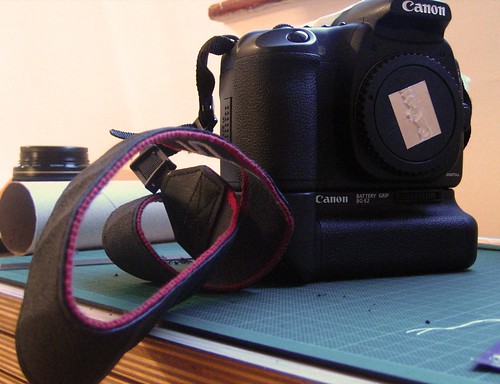
Sisoftroos very kindly got me a cardboard pinhole camera kit for my birthday. I am putting a roll of aged 35mm colour film through it now and I shall be intrigued to see what, if anything, comes out from it. But this set me thinking about making a digital pinhole camera. At first I was over-complicating the issue by planning to make a pinhole camera that was focused onto a ground glass and then using a macro lens on the digicam to take a photo of the image projected onto the ground glass. This is, of course, way too fussy. A quick Google search showed a far more sensible approach:

  1. Take a body cap for your type of camera.
  2. Punch a hole in the centre of it.
  3. Using a needle, make a tiny hole in a piece of adhesive aluminium foil.
  4. Stick that over the hole in the body cap.
  5. Put the body cap onto the camera and...
  6. VoilĂ , you have a made a pinhole camera.
Here's what I've ended up with at the moment:

My latest Canon "lens" in situ.

And this is from my first test at taking a photo with it:

Pinhole 3

I'm really quite pleased. It's very soft; I think a slightly smaller, more carefully punched hole ,will produce better results but it's not bad. The pleasing pin-hole quality of infinite depth of field is there and these days with Photoshop and such we can add some contrast into the otherwise rather flat images the pinhole produces. I'll try and improve the quality of my pin hole and take some more photos over the coming weeks. I might even try and shoot some time-lapse video.

Labels: , , ,

Thursday, October 02, 2008

Photographing Florence

Sorry for the absence of posts this week. I've had a horrible cold from which I'm only just emerging. My eyes are still very sore but at least I'm not pouring snot everywhere. The whole thing rather knocked me for six I'm afraid. As a child I was quite asthmatic, a condition that I fortunately grew out of in adolescence. The only time it rears its ugly head these days is when I get a cold and it goes straight for my chest and I start wheezing like someone who's just climbed twenty flights of stairs. So I've spent most of this week very out of breath and consequently too light headed and dizzy for anything requiring concentration. OK apologies over.

So the photos. I noticed that Booda Baby wanted photos from Santa Croce and there were none. What can I say? Well there are a couple of things, one a circumstance of the day and the other an arbitrary decision I made before we travelled. The on the day problem was that half of Santa Croce's interior was under tarpaulin so we couldn't see any of the Donatello sculpture in there. It wasn't tarped in a way that would have made for an interesting photo either unfortunately. The other reason I didn't take any pictures of that, or of most of the other well-known landmarks, was because I decided to look around me as we mooched around and if I could count 10 people shooting the same photo I was about to take then I stopped. This is partly snobby daftness on my own part but there is a rationale too.

As we were looking through our photos T told me about her grandfather who took countless slides whenever the family went on holiday. He would then show them to anyone who would sit still for long enough to be subjected to them. In the 70s, 80s and early 90s when he was taking them it made sense to really document things. If there was a sculpture or a building that was especially beautiful then recording it for yourself seems sensible, there may be no book featuring it. Today I think that the situation is rather different. If you look on Flickr, Google Images or any of the other repositories of online images there will be countless shots of any famous monument you can think of. Many will be taken by professional photographers who could clear a space or are willing to get up early enough that their pictures will capture the object in the best manner possible. I didn't think it was worth my while trying to compete with them. Florence must be amongst the most documented places on earth: a search on Flickr for "Santa Croce Florence Firenze" yields nearly 3,300 images and I felt that if I were to take a picture it should only be when I really felt I saw something differently rather than just to document something because it was there and beautiful. I hope this makes sense?

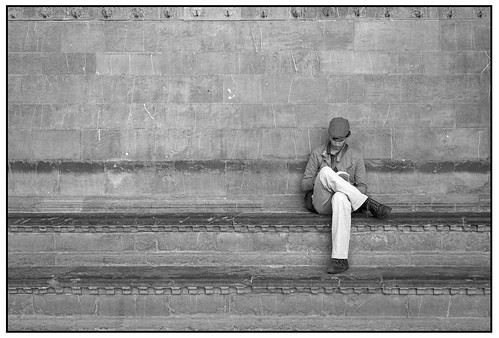
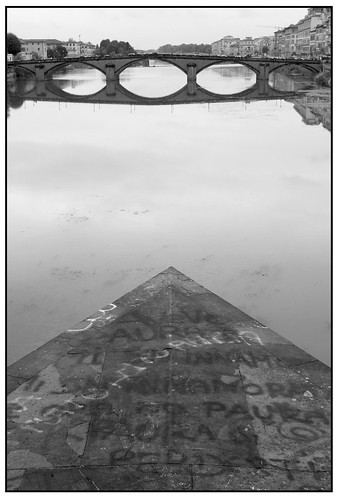
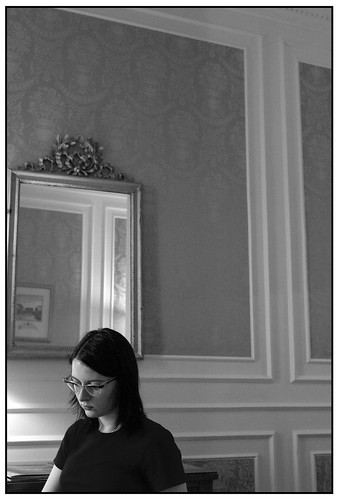
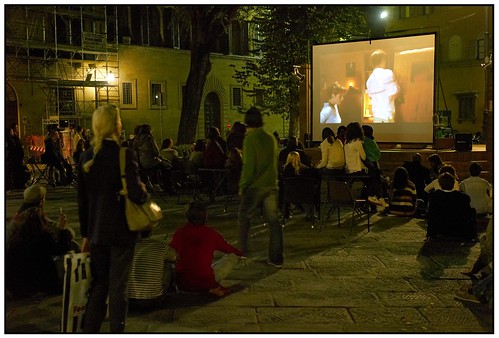
Looking back through my pictures I think these 5 are my favourites, they're the ones that speak most to me about our experience of being in the city rather than recording what we saw.

Reading in the Piazza della Signora

Looking Down the Arno

In the Grand Hotel Villa Medici

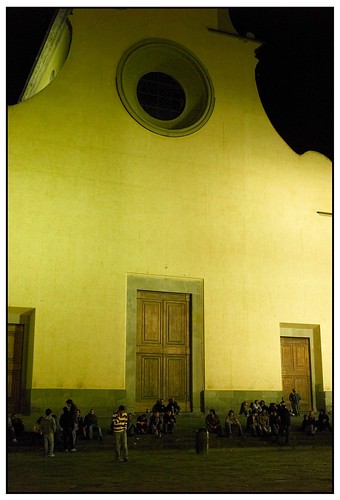
Film in the Piazza Santo Spirito

Sitting and Drinking Outside Santo Spirito at Night

Labels: ,

Thursday, June 05, 2008

My Book Arrived


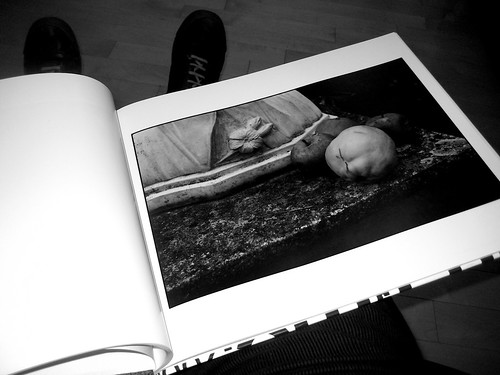
My Book Arrived, originally uploaded by Mr Atrocity.

One of the things I wanted to do during my fortnight's holiday was to finally get my book of photographs designed, laid out, organised and printed. Having evaluated all the possibilities open to me I decided to go with www.blurb.com as their options seemed better in the types of book I could design and the freedom I had with layout and covers. I actually ended up doing two books, one large hardback book and a smaller paperback that I can give to friends as it's a little less expensive to print. I ordered one of each and yesterday my large book arrived at work. I'm really happy with how it turned out, the prints are exactly the right density which is excellent because I have a penchant for printing pretty dark when I can - I like a lot of blacks in my prints and if I'm not careful a less exacting printer could print the pictures too darkly. So I can really recommend Blurb for anyone thinking of self-publishing, it's a great way to get your work, be it photography or text, out there and available for public consumption, if they want it of course.

Check out my books

When the small version turns up, assuming it too is OK quality wise, I shall order a copy for everyone I know who appears in the book. It seems only fair to say thank you for the time they spent putting up with me trying to take their picture.

There is also a competition on Blurb's website for photography books and I reckon I will enter that. I don't think I have a chance of winning but what the hell. Booda Baby cajoled me into it and for that I'm thankful.

Well it's been a long day; I'm working on three shows at once this week and I'm feeling it tonight, so I shall take myself off to bed.

Labels: ,

Friday, February 01, 2008

Rangefinders and Me

Most people don't care what camera they have or if they do take some time to choose they will pick the one with the most mega-pixels or the smallest dimensions. Both of these are important factors but there are some profound effects that different cameras can have on the way we take photographs. I've been thinking a lot about this since I finally saved up enough to get a Leica M8, the digital rangefinder camera and have been reacquainting myself with rangefinder photography.


Over many years of using, film, digital, large-format, medium-format, 35mm Single Lens Reflexes (SLRs) and rangefinders I find that each type of camera has a different character that combined with my own psychological peculiarities profoundly affect the photographs I take.

A quick run through how I got where I am now for context. My first "proper" camera was a second-hand Olympus OM-2, a camera I bought when I was 13 or so.


It was a lovely small 35mm SLR and I used that until I was 18 when my dad allowed me to borrow his medium-format Bronica SQ on a semi-permanent basis.


I used this camera until I was about 20 when my grandfather left me some money in his will with strict instructions to spend it on something. At the time my favourie photographers were Henri Cartier-Bresson and Andre Kertesz, both of whom used Leicas. And so it was that I got my father to pick up a second hand Leica M6 and a 1970s 50mm Summicron lens for me from Campkins Cameras in Cambridge.


I still remember handling it for the first time, the way it felt so natural in my hands. I'd loved the compactness of my OM-2 but for years I'd been used to the Bronica and Mamiyas at college. It was a breath of fresh air to have so small a camera again.

For anyone who has never used a rangefinder camera (which all Leica M series are) it is somewhat different to a SLR. Firstly you don't look through the lens, you look through a viewfinder that presents you with a much wider view of your surroundings. Going back to an SLR feels like looking down a tunnel in comparison. Second rangefinders are smaller than SLRs because they don't have all the mirrors and pentaprisms that SLRs need in order to allow you to look through the lens that puts the light onto the film (or sensor these days). This lack of extra mecahnicals has the added benefit of relative quiet. A rangefinder is much quieter when you press the shutter as the camera has no mirror to quickly get out of the way. Many perople do not like rangefinders because they can't accept long telephoto lenses, are seldom auto-focus and don't give you a depth-of-field preview. Certainly were I a wildlife or sports photographer whose stock in trade is long lens shots I would not choose a rangefinder.

So why do they work so well for me? well the majority of photographs I take tend to be of people within the context of an environment or of an environment alone. In both instances the position and relationship of the me, the photographer, to the scene is very important. I like my photographs to give the viewer the feeling of being a participant in the scene, to be within the environment rather than voyeuristically looking on from afar. For this reason I've never liked using long lenses for my pictures as they have the inbuilt quality of removing the viewer from the centre of the action and compressing depth.

When taking photographs I find the wider viewfinder puts me within my surroundings more; I feel part of the scene rather than feeling like I'm only observing a tiny proprtion of it through the lens. Seeing more than I can shoot helps me anticipate action, enables me to play with different compositions more easily, work out whether I need to move closer to or back off from my subject and all the while knowing that the camera is quiet and discreet enough not to become the centre of attention.

When I finally made the decision to go digital (a mixture of not being able to find the chemicals I liked to use for film processing anymore and a desire for an easier life) I opted to get a Canon 20D, the best semi-pro digital SLR available at the time.


It is a very fine camera but I do have complaints though they would equally apply to any other modern SLR. Firstly, compared to the Leica it is huge. It is very hard to work disreetly; the camera is so big and loud that it draws attention to itself at once; you become the centre of the action rather than reacting to what is going on unobtrusively. Second it tries to automate everything. I find that the more I have to concentrate, the more I take better pictures. By forcing me to focus manually, as the Leica does, I feel more connected to the scene. You can, of course, use Canon lenses without the auto-focus but the manner of their construction is so biased toward automatically focussing that using the lenses manually is rather like driving a car with powered steering compared to one without. I don't feel directly connected to the mechanics of the camera as I do with a fully manual lens.

Similarly I find being forced to manually select aperture and shutter speed also concentrates my mind though this works equally well on the Canon as it does on the Leica so this is not to praise one sort of camera over the other.

Many people vastly prefer auto-focus and auto-exposure because it frees them to concentrate only on composition and when to fire the shutter. I can totally understand that viewpoint but it doesn't work for me. The less I have to do, the lazier and less focussed I become. I end up with
very voyeuristic photographs, exercises in composition rather than photos where I am involved in the action. The Leica, being in effect totally manual, makes me work for my photographs whilst its design and dimension allow me to position myself within an environment and work without becoming the centre of attention, without contaminating the scene too much with my presence. It is for this same reason that I don't use flash, it attracts too much attention to itself, but that's a topic for another post in its own right.

So my point is that there is no "best camera" out there for everyone. I've used pretty much every type of camera there is and I can see merits and applications for all of them (except the Leica R9 which is as God-awful a piece of expensive rubbish as I can think of and I still don't understand what my dad sees in his) but everyone has differing priorities and needs. Choosing the right camera is more than looking in at the brochures to see which is the latest and has the most megapixels. It has to feel right, to sit in your hand and come to your eye naturally. The more your camera helps you concentrate on the moment of taking the picture and the more it feels like an extension of your eye into the world the better the photographs you take will be.

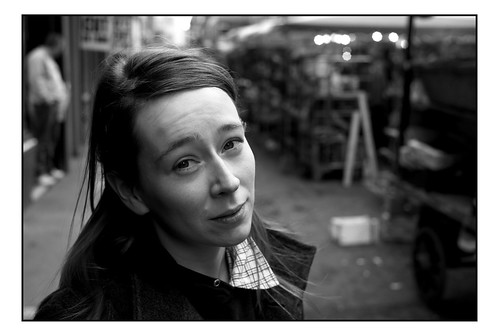
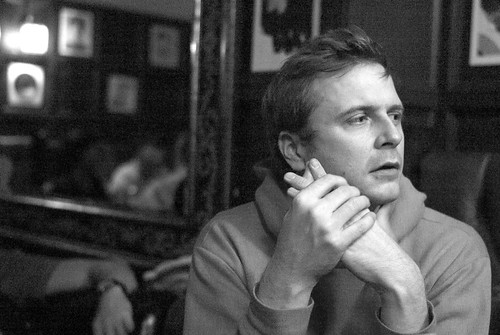
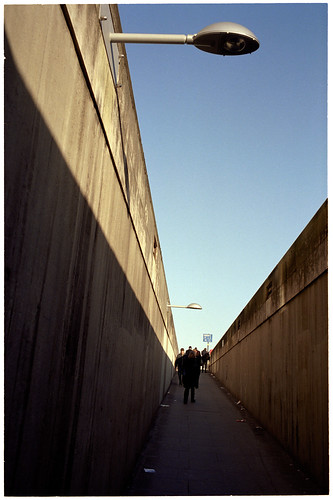
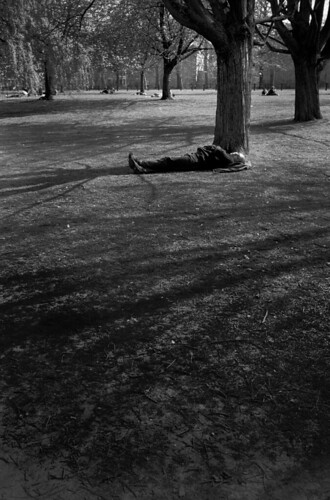
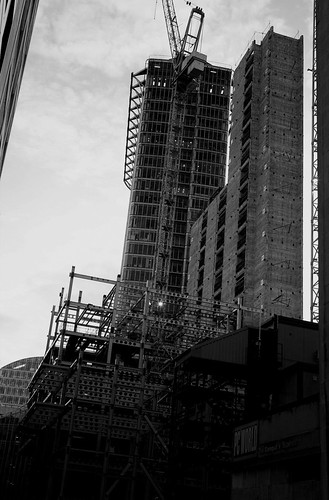
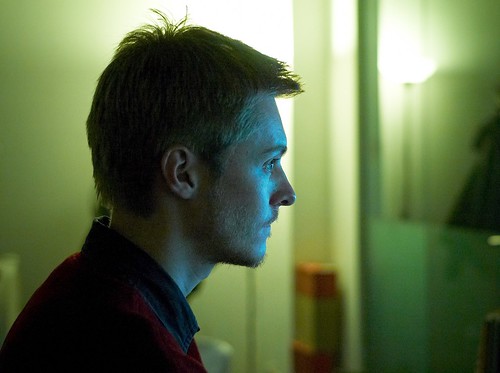
Here are a few photogaphs I don't think I'd have been able to take with a non-rangefinder camera. Rangefinders aren't for everyone but they really work for me:
Heg Quizzical

A Tourist, A Pigeon and Admiral of the Fleet, The First Earl Jellicoe

Adie

Commuters

Lazy Afternoon

Quiet on the Building Sites

Alexander

Labels: , , ,