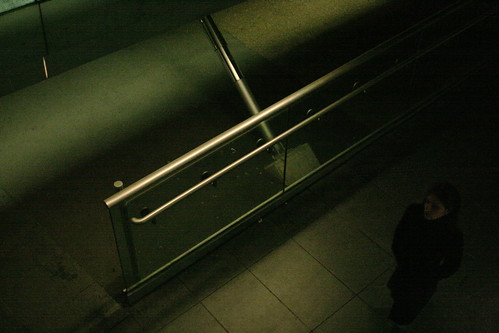
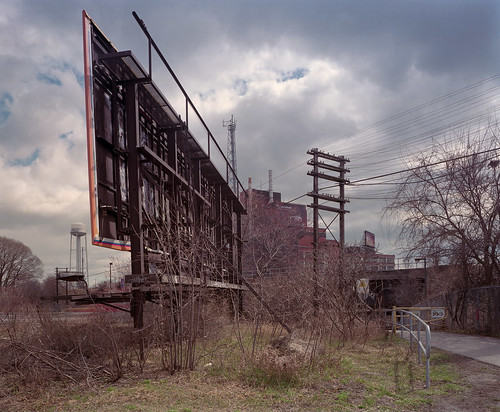
This photograph is also a snapshot of a moment, but it is captured as it was experienced, that is the moment presented here contains the information present to the photographer at the moment it was taken. It is a record of the moment not so much the physical objects that make it up. The image hits us as a whole and we do not gain more from prolonged observation, it captures what an eye at that moment could.
In order to take photographs of the first type you would need a camera of very high quality, probably a plate camera. I dearly love the work of photographers such as Stephen Shore who works exclusively on 10x8 film, the highest quality format practically available. For the longest time I tried to mimic his photographs, initially with my 35mm or medium format film cameras and latterly with a digital SLR. But I never captured what his photographs had. and that is the intricate detail that fascinates the eye in its richness. To put it another way, if you look at a
Willem Kalf painting or a
Caneletto, the delight is in the precision of the image. Your eye may wander about these images always finding something new. The photos I took on lower resolution cameras did not have this quality, they were incapable of resolving that kind of detail and thus they lacked the punch and accutance that I sought.
Having realised this I took to aiming to capture the moment as I perceived it. This was what these lightweight cameras were best at. I could easily have them with me and as something unfolded before my eyes I could could capture that instant as it appeared to me. This is inherently more subjective and puts the viewer inside the eye of the photographer, you the viewer see the instant as I, the photographer, saw it when it was captured. This subjectivity is what I believe leads to the greater critical debate over photographers like
Henri Cartier-Bresson or
Juergen Teller than happens with the masters of larger-format photography such as
Ansel Adams. The taste of the viewer is more easily placated by the higher quality image, there is simply more in it to draw you in, but if you find the aesthetic of a "capture the moment" unappealing there is little else in the image to keep you looking at it. However when you find a capture the moment photographer whose work does connect with you, that connection with the image is often stronger than the more remotely observed large-format image can be. It simply plugs directly into your brain and emotion.
Josef Koudelka and Christopher Doyle's work does this for me.
I think, therefore, that there is a camera to suit all types; I favour smaller, more discrete cameras that enable me to capture moments as they occur, that may be of pretty high quality but not at the expense of portability and unobtrusive size. So, Chulita, that's why I think my camera and I are well suited, it is the right tool for the photographs I've come to realise I like to take best.